
Published
Demo trading before prop firm: Practical guide
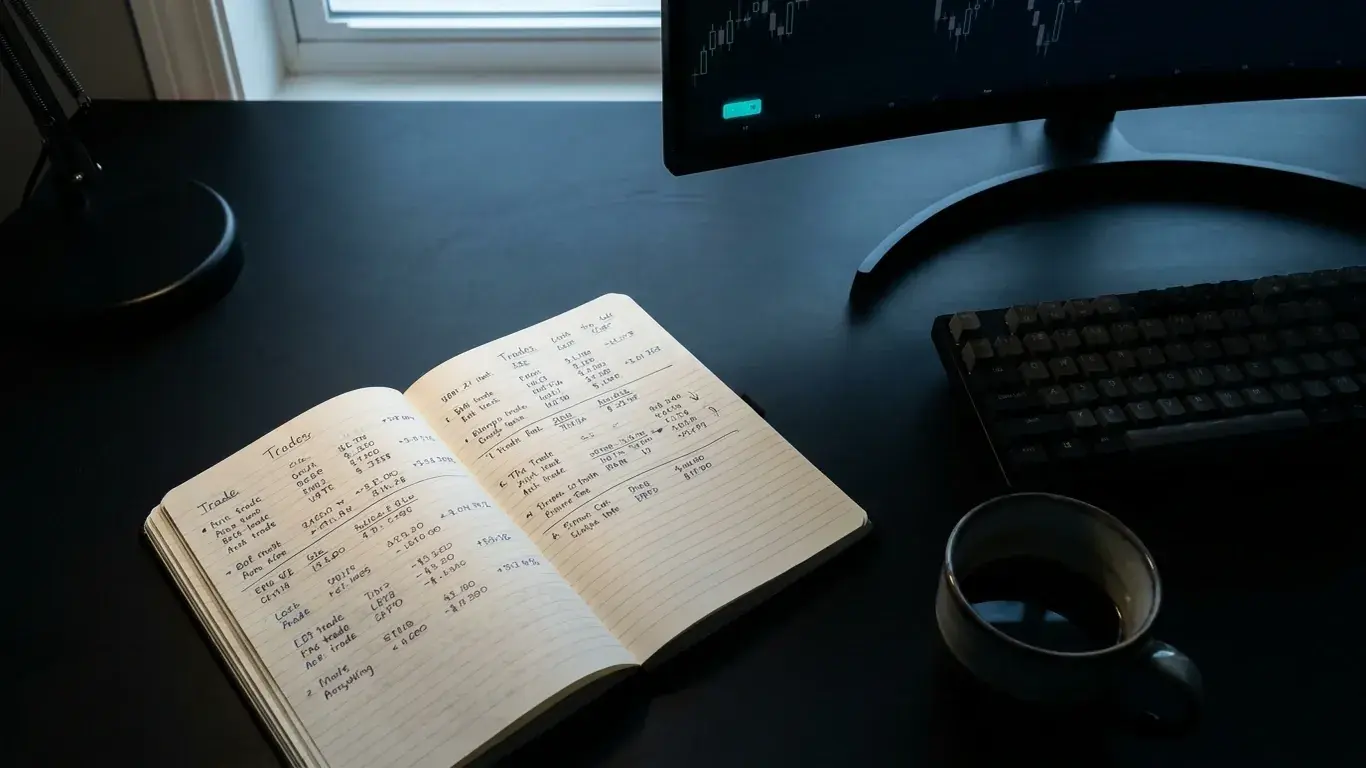
Demo trading before prop firm evaluation is one of the most reliable ways to prepare for a funded-account challenge. Practising in a simulated environment lets traders stress-test strategies, build rule-following habits, and become comfortable with platforms before real evaluation money is at risk. This approach develops the consistency and discipline that prop firm challenges demand.
Why should you do demo trading before a prop firm challenge?
Quick answer
Demo trading before a prop firm challenge lets you build a track record of consistent, rule-governed behaviour in a zero-risk setting, exactly the evidence a prop firm evaluation is designed to test for.
Prop firm evaluations do not reward bravado or lucky trades. They reward traders who follow a defined risk framework across a set number of trading days without breaching drawdown limits. If you have never traded under those specific constraints before, the evaluation itself becomes your learning curve, and you pay for it each time you restart.
Demo trading removes that cost. You can apply the same profit target, daily loss limit, and maximum drawdown parameters on a demo account and observe how your natural trading behaviour interacts with them. Many traders discover during this phase that strategies that felt consistent on a chart look very different when a hard drawdown limit is attached. That discovery is worth far more before a challenge than during one.
There is also a platform familiarity benefit that is easy to underestimate. Order entry errors, confusion about position sizing tools, or uncertainty about how the platform calculates equity can all trigger rule violations that have nothing to do with trading skill. Running your demo sessions on the same platform you plan to use for the evaluation removes those variables before they matter.
How do you use demo trading to prepare for prop firm rules?
Quick answer
Mirror the exact evaluation rules, profit target, daily loss cap, maximum drawdown, minimum trading days, on your demo account from day one, so the constraints feel routine before the challenge begins.
- Set the account size to match the evaluation: Use a demo balance that matches the challenge account size you are targeting. Position sizing decisions change significantly between a smaller and a larger notional balance, and practising at the wrong size builds inaccurate habits.
- Apply the exact risk parameters: Read the evaluation’s rulebook carefully, daily loss limits, maximum drawdown, and whether limits are calculated on balance or equity, then replicate those limits in your demo practice. If you plan to attempt a prop firm challenge, look at resources like what a proprietary trading challenge actually involves and how to pass one so you understand each rule before you replicate it.
- Track every session in a trading journal: Record your entry reason, position size, result, and whether you respected your risk rules. A journal turns scattered trades into a reviewable pattern. If you cannot explain why you took a trade in writing, the reasoning probably would not survive the pressure of a live evaluation either.
- Enforce your own stopping rules: If you reach your daily loss limit on the demo account, stop trading for that day, even though nothing forces you to. The discipline of stopping when a rule says stop is precisely what evaluations test. Skipping that habit in demo practice means you will not have built it by the time the challenge begins.
- Repeat for a statistically meaningful period: A single good week on demo is not enough data. Aim to complete a full simulated challenge cycle, including the minimum required trading days, at least twice before attempting the real thing. Two clean cycles give you evidence of repeatability, which is what consistency actually means. For a broader look at the tools and platforms that support structured practice day trading, it is worth reviewing your options before committing to one.
One thing to watch: Treating the demo account as unlimited retries with no consequences is the fastest way to practise the wrong behaviour. Structure each session as if it counts, because the habits you build here transfer directly.
What common mistakes can demo trading before a prop firm help you avoid?
Quick answer
The most costly mistakes in prop firm evaluations, oversizing positions, ignoring daily loss limits, and abandoning a strategy mid-challenge, are all preventable through structured demo practice that treats rule compliance as non-negotiable.
Position oversizing is the single most common reason traders fail evaluations on their first attempt. The temptation to make up ground quickly after a losing trade is a well-documented psychological pattern, and it almost always results in a drawdown breach. Demo trading with hard self-imposed limits gives you repeated exposure to that temptation in a context where the only consequence is a lesson, not a failed challenge.
Ignoring the daily loss cap is closely related. Traders who have never traded under a daily limit before often do not realize how quickly a bad morning session can consume the full allowance. Running demo sessions with a real daily cutoff, and genuinely stopping when it is reached, makes that boundary feel concrete rather than abstract.
A subtler mistake is strategy Drift: Switching approaches mid-challenge when results are below expectations. Demo practice is the right place to test whether you can commit to one method through a drawdown period. If your demo journal shows multiple strategy switches in a single simulated cycle, that is the pattern to address before paying for an evaluation. Sound prop trading risk management principles apply equally during demo preparation, consistency in approach is as important as any individual risk metric.
One misconception worth correcting directly: Some traders assume demo practice only benefits beginners. In practice, experienced traders who have never traded inside a prop firm rule set also benefit from a structured demo phase, because the constraints are specific and unfamiliar regardless of prior experience.


How do you know when you are ready to move from demo trading to a prop firm challenge?
Quick answer
You are ready when your demo journal shows at least two complete simulated challenge cycles, meeting the profit target without breaching any rule, and you can explain every trade you took in writing, including the ones that lost.
Readiness is not a feeling; it is a pattern visible in your journal. Look for these four conditions before registering for a challenge:
- Rule compliance across both cycles: No daily loss breach, no maximum drawdown breach, and no trades taken outside your defined setup criteria on either simulated run.
- Positive expectancy over a meaningful sample: Your win rate and average risk-to-reward ratio, calculated across at least 30 trades, show that the strategy makes money over time, not just on selected examples.
- Documented trade rationale: Every trade in your journal has a written entry reason. This signals that your decision-making is rule-based rather than reactive.
- Emotional stability during drawdowns: Your journal notes from losing days should show measured responses, not panic entries or recovery trades that violated your sizing rules.
If any of those four conditions is missing, running another demo cycle is the right call, not a sign of stalling. Evaluation fees are real costs, and a third demo cycle costs nothing by comparison. When you do move forward, understanding the full path to getting a funded forex account helps you set realistic expectations for what comes after passing the challenge. Some traders also explore prop firms offering instant funding as an alternative route that skips the evaluation stage entirely, a trade-off worth understanding before you decide which path fits your current readiness level.
FAQ
Demo trading is useful for building rule compliance habits and strategy consistency, which are the primary things prop firm evaluations test. The main limitation is that demo accounts do not replicate the psychological pressure of real money at risk, so the skills you practise are necessary but not fully sufficient. Structured demo practice, where you enforce your own rules strictly, narrows that gap as much as possible before the real challenge begins.
There is no universal answer, but a practical benchmark is completing at least two full simulated challenge cycles, covering the minimum required trading days each time, without breaking any rule. For most evaluation formats, that means several weeks of structured practice rather than days. Quality of the practice matters more than calendar time: Two disciplined cycles with a trading journal provide more useful evidence than six weeks of unfocused trading.
Yes. You can manually replicate most prop firm evaluation rules on any demo account by setting your own daily loss ceiling, tracking your running drawdown against a maximum, and stopping when either limit is reached. The platform itself will not enforce these limits automatically on a standard demo, so you have to apply them through your journal and your own discipline, which is itself useful preparation for the self-governance an evaluation requires.
Demo trading reduces one source of pressure, unfamiliarity with the rules and platform, but it does not fully replicate the emotional weight of a funded evaluation where the entry fee is at stake. Traders commonly report that their first live evaluation feels meaningfully different from demo, particularly during drawdown periods. The best mitigation is to treat each demo session as if it genuinely counts: Enforce your own stopping rules, log every trade, and avoid the habit of restarting freely when a simulated cycle goes badly.
Our Latest Stories
- Company Updates October 17, 2026
Prop Firm Eleonex Signs WBO World Heavyweight Champion Daniel Dubois as Brand Ambassador
The strategic move brings the Eleonex brand closer to a broader audience. Prop firm Eleonex recently inked a brand ambassador deal with British professional heavyweight…
Read More
- Company News October 12, 2026
Eleonex TradeLocker Partnership: New Trading Platform
Eleonex and TradeLocker are expanding the options available to traders, giving Eleonex traders access to TradeLocker as an additional trading platform. October 8, 2026 —…
Read More - Prop Trading October 12, 2026
What is Eleonex and how does its funded trading work?
Eleonex is a prop rietary trading firm that funds disciplined traders with up to $300K in simulated accounts and shares profits through a reward split.…
Read More

Stay Informed,
Stay Ahead
Bookmark this blog to keep your edge sharp. Whether you're prepping for your first challenge or scaling into a six-figure funded account, our insights are here to help.
